


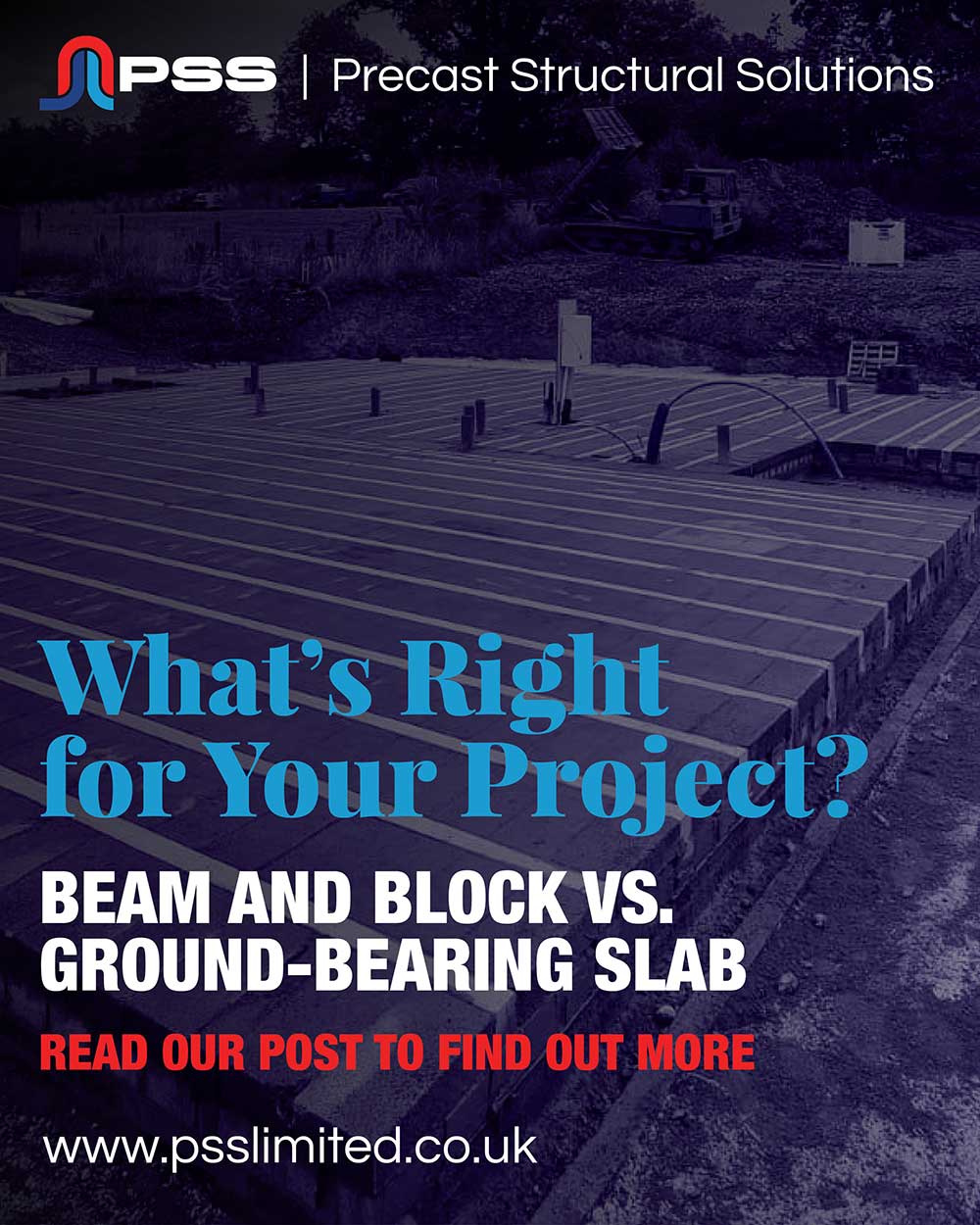
Unlike ground-bearing slabs, which rely heavily on site conditions and require extensive preparation (including hardcore, blinding, insulation, and a concrete pour), beam and block is largely unaffected by ground moisture or variable soil. It’s a suspended floor system — which means it spans across load-bearing walls, avoiding the need for full ground support.
This makes beam and block particularly suitable for sites with poor drainage, clay soils, or where the risk of ground heave is a concern. It also eliminates delays due to wet weather or site saturation — an increasingly common challenge on UK builds.
Another big advantage is its speed and efficiency. With all components manufactured offsite, the floor can be installed quickly by crane. No drying or curing time is needed, so internal works can commence without delay.
Thermal insulation and underfloor heating can be easily incorporated during or after installation, and the system performs well in fire resistance, acoustic separation, and long-term durability.
At PSS Limited, we work closely with your team during the design phase to ensure optimal layout, material specification, and sequencing. Our goal is to reduce site complexity and keep your project moving.
📧 If you’re weighing up your options for ground floor construction, give us a call on 023-8202-1520 or drop us an email at [email protected] — we’d be happy to offer guidance or provide a quote.